
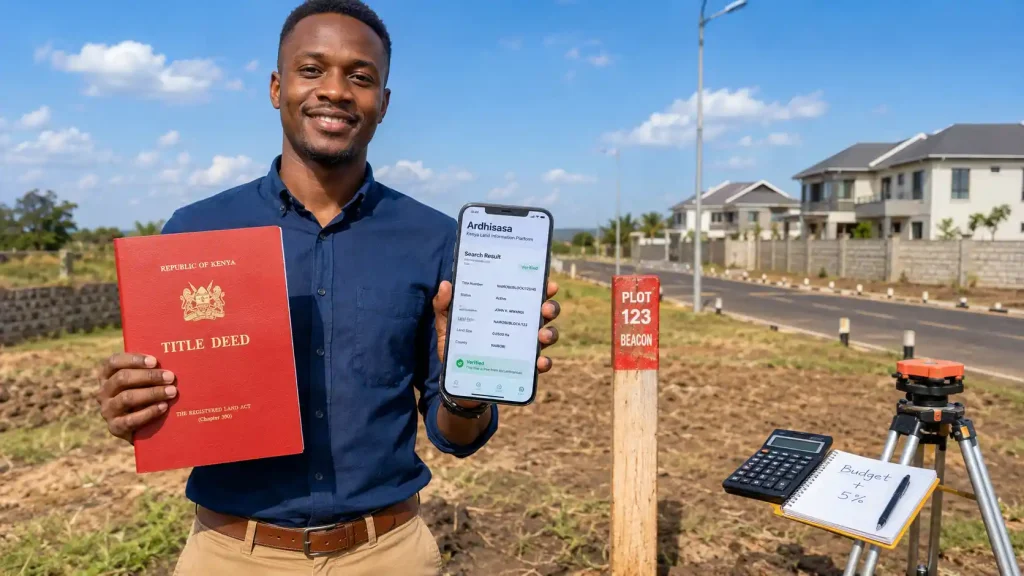
What Does Buying Land in Kenya Actually Involve?
Buying land in Kenya is not as simple as paying money and receiving a document. It is a legal process governed by the Land Registration Act of 2012, administered by the Ministry of Lands and Physical Planning, and requiring multiple verified steps before ownership legally transfers to your name.
The good news is that when you follow the correct process with a registered agent and a qualified advocate, buying land in Kenya is safe, straightforward and produces a legally binding freehold title deed that nobody can take from you. The process typically takes 30 to 60 days from reservation to title deed in your name, and the costs beyond the land price itself are predictable and transparent.
How to Buy Land in Kenya: The Complete Step-by-Step Process
Step 1: Define Your Budget and Goals
Before you look at a single listing, get clear on two things: how much you can spend, and what you want the land for. These two answers will determine the right location, the right plot size and the right type of title deed to look for.
Your total budget is not just the land price. You also need to budget for stamp duty, legal fees, title transfer fees, survey map costs and land rates clearance. As a general rule, add 5 to 8 percent on top of the land price to cover all transfer costs. If a plot costs KSh 950,000, your total spend to completion will be approximately KSh 1,000,000 to KSh 1,025,000.
Step 2: Choose Your Location and Type of Land
Location determines everything: the price you pay today, how much the land is worth in 5 years, how easy it is to build or sell, and how safe the title deed process will be. Research your shortlisted locations carefully. Look for areas with tarmac road access, water and electricity connections, nearby infrastructure and active property registration at the local Lands Registry.
Decide whether you need a serviced plot (water and electricity already connected, road access confirmed), an unserviced plot (cheaper but requires you to bring services yourself), or agricultural land or shamba for farming or land banking purposes. Each type has different price points and different development considerations.
Step 3: Find a Registered and Reputable Agent
A registered real estate agent protects you in ways that a private seller cannot. They have a verifiable business address, a registration number with the Estate Agents Registration Board of Kenya (EARB), and a professional obligation to present accurate information about the properties they list. Before engaging any agent, verify their EARB registration, check their physical office address and request at least two past client references.
Be cautious of sellers operating only through WhatsApp groups or Facebook pages with no verifiable physical presence. Social media is a legitimate marketing channel but it is also widely used by fraudsters targeting first-time buyers.
Step 4: Visit the Land in Person
Never buy land in Kenya without visiting it first. A site visit confirms the physical boundaries match the survey map, the access road is usable year-round, the surrounding area matches what you were shown in photos, and the beacons or boundary markers are in place. Visiting also tells you things that no document can, such as how developed the neighbourhood is, how close the nearest services are, and whether the land feels right for your intended use.
For diaspora buyers who cannot travel, request a live video call tour with your agent walking the exact boundaries of the plot in real time before you commit.
Step 5: Verify the Title Deed Before Paying Anything
This is the most important step in the entire process and the one most first-time buyers are tempted to skip or rush. Conduct an official title deed search through the Ardhisasa government portal at ardhisasa.go.ke or request a physical search at the relevant county Lands Registry. The search costs KSh 500 and takes minutes online or one to three days physically.
The search result must show the seller as the registered owner, no cautions or court orders, no charges or encumbrances, and a parcel number that matches the physical title deed document exactly. If any of these do not match, stop the purchase until the discrepancy is resolved in writing.
Step 6: Engage a Qualified Advocate
Appoint an independent advocate registered with the Law Society of Kenya to handle the conveyancing. Your advocate’s job is to verify the title, review the sale agreement, confirm stamp duty calculations, prepare transfer documents and submit the transfer application to the Ministry of Lands. Advocate fees are typically 1 to 2 percent of the purchase price and are one of the most valuable investments in any land transaction.
Use an advocate who is independent of the seller. Do not accept an advocate appointed and paid by the seller to act for both parties.
Step 7: Sign the Sale Agreement
The sale agreement is a legally binding contract between you and the seller setting out the purchase price, payment timeline, transfer conditions and remedies in case of breach. Read it carefully with your advocate before signing. Confirm that the price matches what was agreed verbally, the transfer timeline is clearly stated, and the title deed transfer is made conditional on full payment only.
Pay a reservation deposit only once a sale agreement is signed. Never pay a deposit based only on a verbal agreement or a WhatsApp conversation.
Step 8: Pay Through a Documented Channel and Keep Records
All payments for land purchases in Kenya must be made to a verified business bank account or an advocate’s client account, with a written receipt issued for every transaction. Keep copies of all bank transfer confirmations, Mpesa receipts and payment receipts. These records form part of your legal evidence of purchase and will be required at the Ministry of Lands during the transfer process.
Step 9: Complete the Transfer and Receive Your Title Deed
Once full payment is made, your advocate submits the transfer documents to the Ministry of Lands together with your KRA PIN, the stamp duty payment receipt, the land rates clearance certificate and the signed transfer form. The Ministry processes the transfer and issues a new title deed in your name. For most straightforward transactions this takes 14 to 30 working days. You are now a registered landowner in Kenya.
Documents You Need to Buy Land in Kenya as a First-Time Buyer
Prepare these documents before you begin the purchase process. Having them ready in advance avoids delays at the critical stages of payment and transfer registration.
Buyer documents
- Valid Kenyan national ID card or passport. Both sides of the ID are required for the transfer forms.
- KRA Personal Identification Number (PIN). Required for stamp duty payment and Ministry of Lands registration. Apply free online at itax.kra.go.ke if you do not have one.
- Two recent passport-size photographs.
- Bank statements or payment records showing the source of your purchase funds. Required for large transfers above KSh 1,000,000.
Documents to request from the seller
- Original title deed or certified copy of the title deed.
- Official land search certificate from Ardhisasa or the relevant Lands Registry dated within the last 30 days.
- Survey map showing the parcel boundaries, size and the high water mark setback if the land is coastal.
- Land rates clearance certificate from the county government confirming all outstanding land rates have been paid.
- Seller’s national ID or passport matching the name on the title deed exactly.
- Seller’s KRA PIN certificate.
Documents your advocate will prepare
- Sale agreement between buyer and seller.
- Transfer forms for submission to the Ministry of Lands (Form RL1 and supporting documents).
- Stamp duty assessment and payment confirmation.
- Consent to transfer from the relevant authority if required (for leasehold or agricultural land).
- Application for registration of transfer to the Land Registry.
Full Cost Breakdown for Buying Land in Kenya in 2026
Beyond the land price, there are several additional costs every first-time buyer must budget for. Here is a full breakdown of what to expect when buying land in Kenya in 2026.
| Cost Item | Rate or Typical Amount | Notes |
|---|---|---|
| Land price | Agreed purchase price | The base amount paid to the seller |
| Stamp duty | 2% of value for agricultural or rural land / 4% for urban land | Paid to Kenya Revenue Authority before transfer |
| Land transfer fee | Approximately 1% of purchase price | Paid to Ministry of Lands |
| Advocate legal fees | 1 to 2% of purchase price | Your conveyancing advocate |
| Land search fee | KSh 500 online / KSh 500 to 1,000 at registry | Paid at Ardhisasa or Lands Registry |
| Survey map copy | KSh 1,000 to 5,000 | Obtained from Survey of Kenya |
| Land rates clearance | KSh 500 to 2,000 | County government, paid by seller usually |
| Valuation fee | Varies by county and property value | Required for stamp duty assessment |
As a practical rule, budget an additional 5 to 8 percent on top of the land price to cover all transfer costs comfortably. For a plot priced at KSh 950,000, total costs to completion will typically fall between KSh 997,500 and KSh 1,026,000. For a KSh 5,500,000 plot, budget an additional KSh 275,000 to KSh 440,000 for all costs combined.
At Wemark Properties, all fees are communicated in full before you sign anything. There are no surprise costs added after the sale agreement is executed.
How to Choose the Right Location When Buying Land in Kenya for the First Time
Location is the single biggest driver of land value, appreciation and development potential. These are the factors every first-time buyer should evaluate before committing to a location.
- Road access. Land that can only be reached by a rough seasonal road is difficult to develop and difficult to sell. Prioritise plots with permanent tarmac or all-weather murram road access to the nearest town.
- Water and electricity access. Confirm whether the plot has municipal water, a borehole, or an accessible water source nearby. Check the distance to the nearest electricity pole. Plots without utilities are cheaper to buy but more expensive to develop.
- Active land registration in the area. Some areas have title deed backlogs or irregular registration histories. Ask your agent whether the Lands Registry for the area is actively processing transfers and how long recent transfers in that corridor have taken to complete.
- Proximity to infrastructure and amenities. Land near a school, hospital, trading centre, tarmac road or growing town appreciates faster than isolated land with nothing nearby. Think about what is coming to the area, not just what is there today. Energy projects, road upgrades and new developments are strong indicators of coming appreciation.
- Your intended use. Residential building, shamba farming, business premises, rental development and land banking all have different ideal locations. Be honest about what you actually plan to do with the land in the first 3 to 5 years before choosing a location primarily based on price.
Best Locations for First-Time Land Buyers in Kenya in 2026
| Location | Best For | Starting Price | Key Advantage |
|---|---|---|---|
| Baolala, Malindi | First plot, land banking, shamba | From KSh 99,000 | Freehold with title deed at lowest entry price on Kenya coast |
| Malindi-Watamu Road | Beach plot, eco-tourism, investment | From KSh 950,000 | Ocean proximity at accessible price |
| Casuarina, Malindi | Build-ready residential, rental investment | From KSh 5,500,000 | Serviced, secured, 6 min from Malindi CBD |
| Ruiru, Nairobi | Residential near capital | From KSh 1,500,000 | Strong rental demand, near Nairobi CBD |
| Kitengela, Nairobi | Residential, affordable | From KSh 800,000 | Growing satellite town, good road access |
7 Costly Mistakes First-Time Land Buyers Make in Kenya and How to Avoid Them
- Paying money before verifying the title deed. This is the most common and most devastating mistake. Always run an official Ardhisasa or Lands Registry search before paying any amount, including a reservation deposit. Verification costs KSh 500 and takes less than a day online. There is no excuse to skip it.
- Buying land without visiting it. Photographs and videos are not substitutes for a site visit. Boundaries shift, access roads are misrepresented and surrounding land uses change. Always visit the plot in person or arrange a live video walkthrough before committing.
- Relying on a verbal agreement without a written sale agreement. In Kenya, verbal agreements for land transactions have no legal standing. Every land purchase must be governed by a written, signed sale agreement drafted or reviewed by a qualified advocate before any payment is made.
- Not budgeting for transfer costs. Many first-time buyers arrive at the transfer stage without enough money to cover stamp duty, legal fees and registration costs. Budget 5 to 8 percent above the land price before you agree to buy so you are not caught short at the most critical stage.
- Buying land in a community or family agreement rather than a registered government title. Family land agreements, community trust arrangements and informal subdivision documents are not registered government titles and cannot be used to obtain a mortgage, sell legally to a third party or protect your ownership in a court dispute. Only buy land with a registered title deed issued by the Ministry of Lands.
- Using the seller’s advocate without appointing your own. Some sellers offer to handle the entire legal process through their own advocate as a convenience. This is a conflict of interest. Your advocate works for your interests alone and must be independent of the seller and their agent.
- Rushing because of urgency or a limited-time offer. Legitimate land deals do not expire in 24 hours. Any seller pressuring you to pay before you have completed verification, spoken to an advocate and visited the land should be treated with serious suspicion. Taking 3 to 5 additional days to complete proper due diligence is always worth it.
Buying Land in Malindi for the First Time: Why Wemark Makes It Simple
Wemark Properties has guided hundreds of first-time land buyers through the purchase process in Malindi and across Kilifi County since 2018. We understand that buying land for the first time is both exciting and nerve-wracking, and we have built our process specifically to remove the uncertainty.
Every property we list has been title-verified before it goes online. We share the official land search certificate with every buyer as standard so you can confirm ownership without having to find the Lands Registry yourself.
We arrange free site visits to every listed property so you see exactly what you are buying before you sign anything. Our team explains every step of the process in plain language, including the exact costs you will pay and when you will pay them. There are no hidden charges added after the sale agreement is signed.
Our partner surveyors Geoloc handle the full Ministry of Lands transfer process and keep you updated until your title deed is issued. For first-time buyers, having this support makes the entire process significantly less stressful and significantly safer.
Current Land for First-Time Buyers in Malindi
If you are buying land in Kenya for the first time and the Kenya coast is your target, Wemark currently lists the following verified freehold properties across every budget.
Azizi Gardens — 1/8 acre freehold plot in Baolala, Malindi. Title deed inclusive. KSh 99,000. The most affordable registered land available in the Malindi market with a clean government title.
Nuru Gardens — 1/8 acre freehold inland plot in Baolala, Malindi. Title deed inclusive. KSh 130,000. Flat terrain next to the Malindi Global Solar project.
Ocean Breeze Gardens — 1/8 acre beach plot on the Malindi-Watamu Ring Road. KSh 950,000. Freehold title, 5 minutes from Watamu Marine National Park.
Paazuri Serviced Plots — 700 SQM freehold serviced plots in Casuarina, Malindi. Water, electricity and tarmac road on site. KSh 5,500,000.
All listings include a free site visit, verified title deed and full transfer support as standard.
First-Time Land Buying in Kenya: Frequently Asked Questions
How much money do I need to buy land in Kenya for the first time?
You can buy registered freehold land in Kenya from as little as KSh 99,000 for a 1/8 acre inland plot with a title deed included. Budget an additional 5 to 8 percent on top of the land price to cover stamp duty, legal fees and transfer costs. So for a KSh 99,000 plot, total costs to completion will be approximately KSh 104,000 to KSh 107,000.
How long does it take to buy land in Kenya?
The full process from reservation to title deed in your name typically takes 30 to 60 days for a straightforward freehold transfer in Kenya. The main steps are title verification, sale agreement signing, stamp duty payment and Ministry of Lands registration. At Wemark Properties in Malindi, most transfers complete within 30 days of full payment.
Do I need a lawyer to buy land in Kenya?
While not legally compulsory in every case, using an independent advocate is strongly recommended for every first-time land buyer in Kenya. An advocate verifies the title, prepares the sale agreement, calculates stamp duty, handles Ministry of Lands registration and protects your interests throughout the process. Their fee of 1 to 2 percent of the purchase price is one of the most important costs you will spend.
What is the difference between freehold and leasehold land in Kenya?
Freehold land means you own it permanently with no expiry date. Leasehold land means you hold it for a fixed period, typically 33, 66 or 99 years, after which the lease must be renewed with the government. For first-time buyers, freehold is the stronger and more secure form of ownership. All Wemark Properties listings are sold with freehold title deeds.
How do I know if a title deed is genuine in Kenya?
Run an official land search on the Ardhisasa government portal at ardhisasa.go.ke or visit the relevant county Lands Registry. The search costs KSh 500 and returns the official registered owner, parcel details and any encumbrances. If the search result matches the physical title deed and shows no cautions or charges, the title is clean and genuine. Never accept a title deed without running this verification first.
Can I buy land in Kenya without visiting it in person?
It is possible but not recommended. If you genuinely cannot visit, insist on a live video tour with your agent walking the exact boundary of the plot in real time, showing the access road, surrounding land and nearest landmarks. Request a surveyor’s report confirming the plot boundaries. Combine this with an official title search and an independent advocate review before committing any payment.
Ready to Buy Your First Plot in Kenya? Start with Wemark.
Wemark Properties is a registered real estate agency in Malindi specialising in freehold land for first-time buyers, investors and diaspora clients across Kilifi County and the Kenya coast. Every listing is title-verified, every purchase is fully supported and every title deed is transferred cleanly within 30 days of final payment.
Browse our current listings from KSh 99,000, or call and WhatsApp us on +254 759 159 538 to speak with our team, ask any question and book your free site visit. We are available Monday to Saturday and have guided first-time buyers from every background through a smooth, safe land purchase in Malindi.