Shimba Hills National Reserve
Most people staying in Diani Beach have no idea that one of Kenya’s most rewarding wildlife destinations sits just half an hour away. No flight. No five hour drive. No detour through Nairobi. Just a short road inland from the south coast, and you’re in a coastal forest reserve that very few tourists ever discover.
Shimba Hills is quiet, uncrowded, and genuinely special. It’s home to the sable antelope, an animal found nowhere else in Kenya, and to one of the country’s most intact coastal forest ecosystems. If you’re staying in Diani and want to see wildlife, this should be your first stop.
| Location |
Kwale County, southern coast of Kenya |
| Size |
192 km², plus the neighboring Mwaluganje elephant sanctuary |
| Distance |
~30 km from Diani Beach (30 to 40 minutes)
~50 km from Mombasa’s south coast (45 to 60 minutes)
~80 km from Mombasa city center (1 to 1.5 hours, including the Likoni ferry) |
| Climate |
Cooler than the coast, wooded hills, green year-round |
| Wildlife |
Sable antelope, elephant, buffalo, leopard, bushbuck, waterbuck, warthog, colobus monkey, mongoose |
| Birdlife |
Over 230 recorded species, including rare coastal forest specialists |
| Best for |
Day trips from Diani, family safaris, forest walks, birdwatching, quiet uncrowded safaris |
| Best months |
Year-round. Still accessible during the rainy season |
| Signature experience |
The only place in Kenya where you can see a sable antelope |
Why Shimba Hills is Kenya’s most underrated safari

Say the word “safari” in Kenya and most people picture the Maasai Mara, Amboseli, or Tsavo, wide-open savannah and long hours on the road. Shimba Hills doesn’t fit that picture at all. It’s smaller, coastal, and far less talked about.
And that’s exactly its strength.
Tucked inland from Diani Beach in Kwale County, Shimba Hills covers just 192 km² of rolling forest, grassland, and wooded valleys. The landscape is lush and green, a world away from the dry savannah parks. It’s cooler, quieter, and altogether more intimate.
The reserve is jointly managed by the Kenya Wildlife Service and the local Shimba Hills Ecotourism Society, with strong community involvement. Many of the guides grew up around the reserve and know it inside out.
But the main draw is this: Shimba Hills is the only place in Kenya where you can see a sable antelope. That alone justifies the short 30 minute drive from Diani.
Add forest elephants, guided walks, coastal birdlife, minimal traffic, and fresh hillside air, and you’ve got one of the most rewarding half or full day safaris on the Kenyan coast.
Wildlife in Shimba Hills: What You’ll See
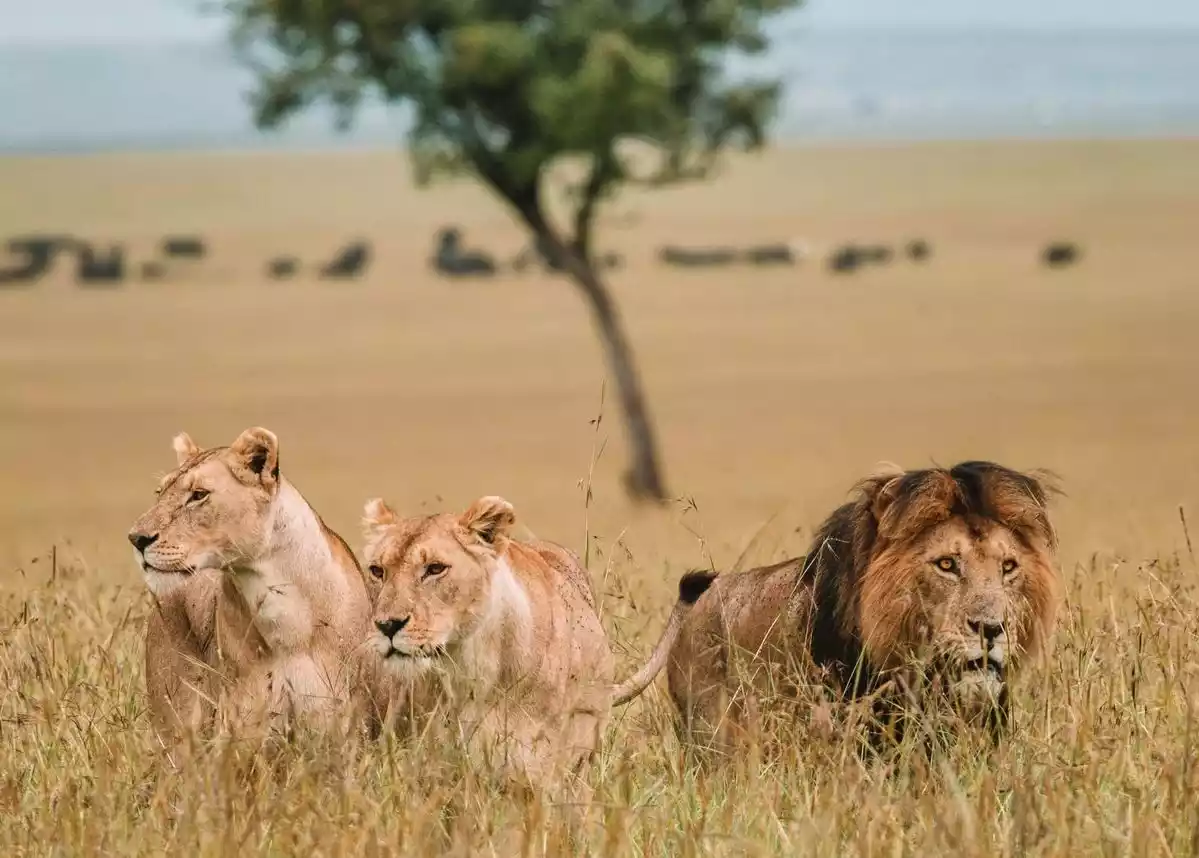
Shimba Hills isn’t a Big Five destination. That’s not a shortfall, it’s simply a different kind of experience. Here’s what lives here and what you can realistically expect to see.
The sable antelope: found nowhere else in Kenya
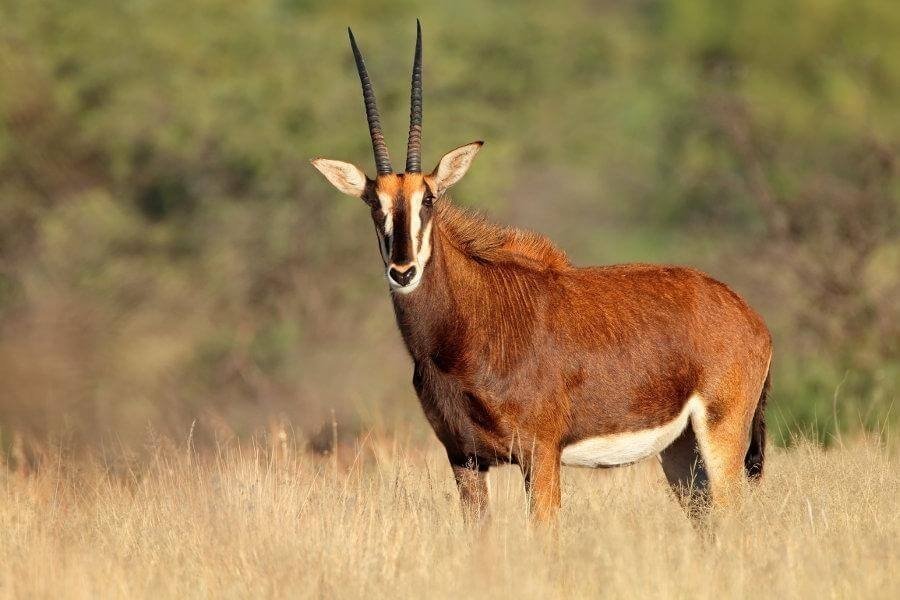
The sable antelope is one of the most striking animals in Africa. Males are jet black with dramatic backward-curving horns reaching up to 165 cm, while females are chestnut brown with white markings.
In Kenya, Shimba Hills National Reserve is the only protected area where sable antelope still survive. Around 120 individuals live here under active conservation management.
The best time to spot them is early morning, while they graze on the southern grasslands. With experienced local guides, the odds of a sighting are excellent.
Seeing an adult sable antelope in the wild is a rare and genuinely memorable moment on any Shimba Hills safari.
Elephants in the Shimba Hills forest

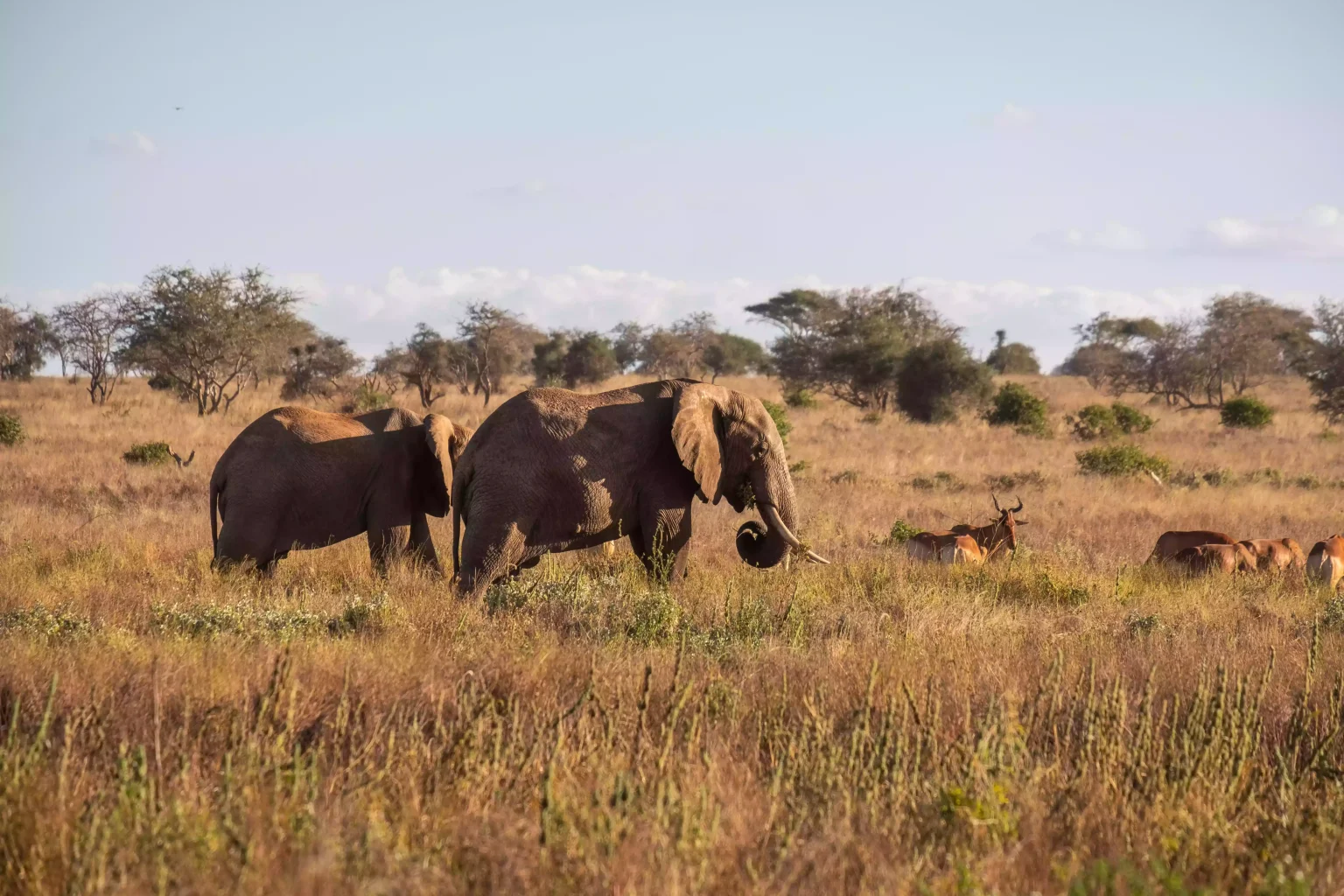
Shimba Hills is home to over 250 elephants, a large population for a reserve of this size. Nearby conservation efforts include the Mwaluganje Elephant Sanctuary, which extends their natural range.
Elephant sightings here often feel close and immediate, thanks to the wooded terrain. Safaris can also be extended into Mwaluganje for a fuller elephant experience in more open landscapes.
For coastal visitors, this offers one of the most accessible and rewarding elephant encounters in Kenya.
Leopards, buffalo and other mammals

Shimba Hills National Reserve holds a good variety of wildlife beyond its famous sable antelope.
Leopards are present and occasionally spotted during morning safaris near the forest edge. Sightings come down to luck, but the dense coastal forest provides ideal habitat and supports a healthy population.
Buffalo are common on the open grasslands, while waterbuck are often seen near streams and clearings. Bushbuck prefer forest cover and turn up regularly along the shaded trails. Warthogs are plentiful, often seen grazing calmly near the road.
The reserve is also known for the striking Angolan colobus monkey, easily recognized by its black and white coat and long flowing tail. Blue monkeys and vervet monkeys are commonly spotted in the forest canopy too.
Shimba Hills offers a rich mix of forest and savannah wildlife, all within easy reach of the Kenyan coast.
Birdlife in the Shimba Hills, a coastal forest specialist hotspot

The Shimba Hills hold over 230 bird species, with a strong presence of coastal forest specialists not found in the drier inland parks. For birdwatchers, the reserve is outstanding, particularly for the East African coastal forest biome, considered one of the world’s biodiversity hotspots and increasingly threatened outside protected areas.
Notable species include the Amani sunbird, the Sokoke scops owl (one of Africa’s rarest owls, found only in East Africa’s coastal forests), the African broadbill, the crowned eagle, and Fischer’s turaco. Early morning forest tracks, alive with canopy activity, offer some of the best birdwatching on the coast.
Even visitors who aren’t birdwatchers notice the birds here. The colors and calls in this coastal forest are impossible to miss.
Sheldrick Falls: the forest walk you didn’t know you needed

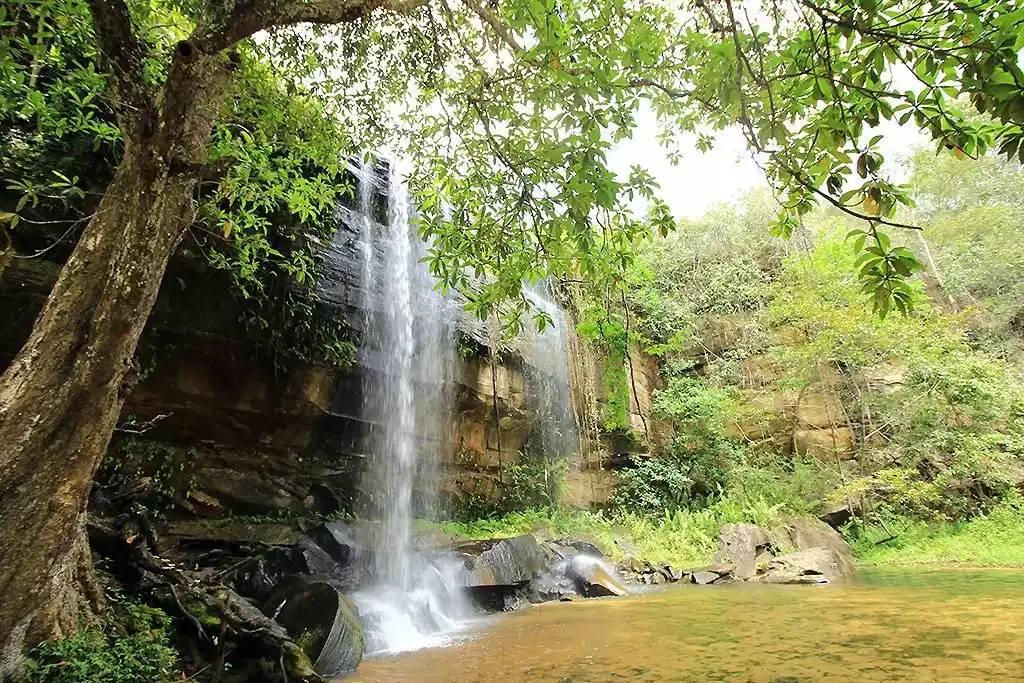
Tucked away in the Shimba Hills, Sheldrick Falls is one of the most beautiful waterfalls on the Kenyan coast. A 21 meter drop through dense coastal forest, ending in a clear pool below, reached via a guided 1.5 km trail from the Shimba Hills Lodge area.
The 45 minute walk each way winds past centuries old trees and crosses small streams, finishing with a steep descent to the viewpoint. The natural pool stays cool year-round, gentle in the dry season, powerful and full after the rains.
Even visitors who aren’t especially drawn to wildlife tend to love this part of the trip. It’s a refreshing escape that beach hotels simply can’t offer, and one worth building into your day.
The landscape: terrain, forest, and ocean views
Sitting at 200 to 450 meters above sea level, Shimba Hills is noticeably cooler than the coast. On clear mornings, the higher viewpoints give you a look at the Indian Ocean, a rare setting where ocean and forest meet in a single view.
The reserve combines open grassy uplands with wooded valleys, offering varied scenery within a short drive. Its coastal forests carry real global significance, part of a biodiversity hotspot with more endemic species per square kilometer than most African ecosystems.
The air feels crisp, the light keeps shifting, and you’ll swear you’re far from the coast, even though you’re really only 30 minutes from the beach.
Everything you need to know before visiting Shimba Hills
How to get to Shimba Hills from the coast
From Diani Beach, it’s a straightforward 30 km drive via Kwale. From Mombasa, allow 1 to 1.5 hours, plus time to cross by ferry from the north coast. We handle all the transport and logistics, so you can just sit back and enjoy the ride.
Park fees
As a KWS managed reserve, standard non-resident rates apply, plus a small entry fee for the Sheldrick Falls walk. All park entry fees are already included in our quoted price.
What to pack
Bring a light jacket for the cool mornings, and comfortable shoes for the walk to the falls. Don’t forget binoculars for birdwatching, insect repellent, and a camera with both zoom and wide angle options.
Best time to visit
Thanks to its forest microclimate, Shimba Hills stays green and full of wildlife all year round. For birdwatchers, the migration season from April to June is ideal. To see the falls at their most powerful, visit during the green season. For the best chance of spotting the sable antelope, the dry season offers clearer visibility. The honest answer is there’s really no wrong time to go.
Shimba Hills Safari: Frequently Asked Questions
Can you visit Shimba Hills in a day from Diani?
Yes, absolutely. A full day (8 to 10 hours) works perfectly. You’ll go on a safari, hike to Sheldrick Falls, have lunch at the lodge, and take in the views. You’ll be back at the beach by evening.
How difficult is the walk to Sheldrick Falls?
Let’s be honest about this. It’s harder than most people expect.
The distance is 2.5 km each way. That doesn’t sound like much. But it’s steep, there are steps, and it gets hot. If you’re reasonably fit, you’ll manage it just fine. If you get little exercise, have knee issues, struggle with heights, or aren’t comfortable on steep descents, think it over first.
Can you see the Big Five in Shimba Hills?
No. There are no lions in Shimba Hills. Leopards are present, but they’re nearly impossible to spot in the dense forest. There are no rhinos.
Is Shimba Hills good for kids?
For the safari itself, yes. Kids love seeing elephants and monkeys.
For the Sheldrick Falls hike, it depends on the child. I’ve taken 8 year olds who bounded up and down like mountain goats. I’ve also seen exhausted, grumbling 12 year olds. The official recommendation is that it’s not suitable for children under 6.
If your kids are young, consider doing just the safari and skipping the hike, or have one parent do the walk while the other waits with the children.
Are there tsetse flies? I’ve heard bad things.
Yes, tsetse flies do exist in the denser forest areas of Shimba Hills. They’re drawn to dark colors, especially dark blue and black.
Here’s how we handle it:
- We recommend guests wear light colors (khaki, beige, light brown)
- We keep windows closed through the areas where they’re most active
- Some guides carry a cow tail fly whisk for the stretches locals call “Kwakia”
- These flies can bite through thin fabric, so it’s worth covering up well